The Ultimate Guide to Moroccan Rug Sizes: Which One Fits Your Room?
Posted by KAOUTAR TAKI

Choosing the right Moroccan rug size has less to do with the room on paper and more to do with how the room actually works. A good rug should anchor furniture pieces, improve circulation, and help the room feel composed.
That is why this Moroccan rug sizes guide starts with layout, not decoration. Before you choose a rug, measure the seating area, the dining table footprint, or the sides of the beds that need coverage. Then think about pile height, traffic flow, and how much bare floor should stay visible.
A reliable rule is to leave about 12 to 18 inches of bare floor between the rug edge and the wall in most rooms. That border gives Moroccan rugs presence without making the room feel crowded.
For a general placement reference, Good Housekeeping's living room rug size guide is useful. For background on traditional woven forms, the Wikipedia pages on Berber carpets and kilims offer helpful context.
Quick room-by-room size guide
| Room | Best starting size | What the rug should do |
|---|---|---|
| Living room | 8×10 | Catch the front legs of the sofa and chairs |
| Large living room | 9×12 | Hold the full seating arrangement together |
| Queen bedroom | 8×10 | Extend beyond both sides and the foot of the bed |
| King bedroom | 9×12 | Create a generous landing on both sides |
| Dining room | 8×10 or 9×12 | Keep chairs on the rug when pulled back |
| Hallway | Runner | Leave floor visible on both sides |
| Entryway | 3×5 or 4×6 | Frame the entry instead of covering it wall to wall |
How to choose a rug without guessing
Ask four things before you buy:
- Where do the front legs land? In a living room rug layout, this matters more than total square footage.
- How much floor should stay visible? That decision changes the room's visual weight.
- Will chairs move across the surface? This is critical in the dining room and home office.
- What pile height suits the room? Plush rugs add warmth in bedrooms, while flatter weaves stay easier to clean in high traffic areas.
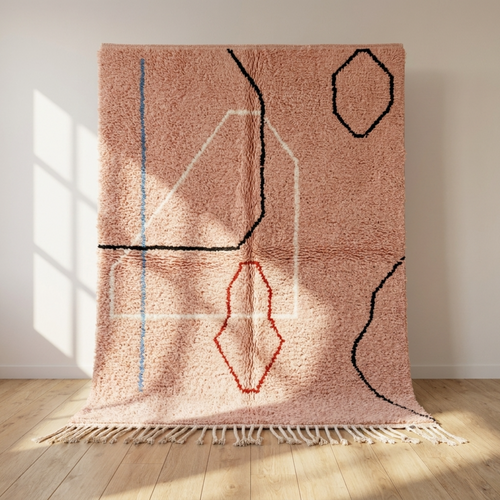
Plush Beni Ourain rugs usually work best in living rooms and bedrooms. Flatweave kilims make more sense in dining rooms, hallways, kitchens, and other busy spots.
Best rug sizes for living rooms
For most homes, 8×10 is the safest living room rug size.
- Small living room: 5×8 or 6×9
- Average living spaces: 8×10
- Large living room: 9×12
- Open-plan seating zone: 10×14 when several furniture pieces need to read as one composition
A simple test helps here. If the coffee table sits on the rug but every sofa and chair leg floats off it, the rug is too small. In many cases, a larger rug will make the space feel calmer and better proportioned.
If the room already has strong upholstery or artwork, a quieter geometric rug often works better. If the palette is restrained, Moroccan rugs create movement and texture without making the room feel busy.

For more styling ideas, see our guide on how to layer rugs like an interior designer.
Best rug sizes for bedrooms
A bedroom rug should soften the room visually, but it also needs to create a comfortable landing when you step out of bed.
- Twin bed: 5×8 or 6×9
- Full bed: 6×9
- Queen bed: 8×10
- King bed: 9×12
The most reliable placement is under the lower two-thirds of the bed. That keeps enough coverage along the sides of the beds and at the foot, where the rug improves daily use.
This is where rugs add warmth most effectively. If you want a quieter look, an ivory or lightly patterned piece usually ages better than a very busy motif.

If you are still comparing materials and weave quality, this Moroccan wool rug quality checklist is a useful companion.
Best rug sizes for dining rooms
A dining room rug has one non-negotiable job: chairs should stay on the rug when guests pull them back from the table.
Leave at least 24 inches of rug beyond every side of the dining table.
- 4-seat table: 6×9
- 6-seat table: 8×10
- 8-seat table: 9×12
For most homes, a flatweave dining room rug is the practical choice. It keeps chairs stable, stays easy to clean, and handles crumbs better than a deep pile.
Best rug sizes for hallways and entryways
Runners work best when they define movement rather than fill every inch of floor. In a hallway, leave a visible border on both sides and stop the rug short of the wall at each end.
In an entryway, smaller rugs or flatweaves often work best. They can add warmth right away while still handling shoes, traffic, and door clearance.

Common sizing mistakes to avoid
The first mistake is buying too small. The second is choosing a rug that nearly reaches the walls and makes the room feel crowded. The third is ignoring function.
Final takeaway
When you choose a rug, start with the layout, not the label. Measure the seating zone, the dining area, or the bed placement first. Then decide whether the room needs plush softness or a flatter weave suited to high traffic areas. Once those choices are clear, the right Moroccan rug size becomes much easier to spot.